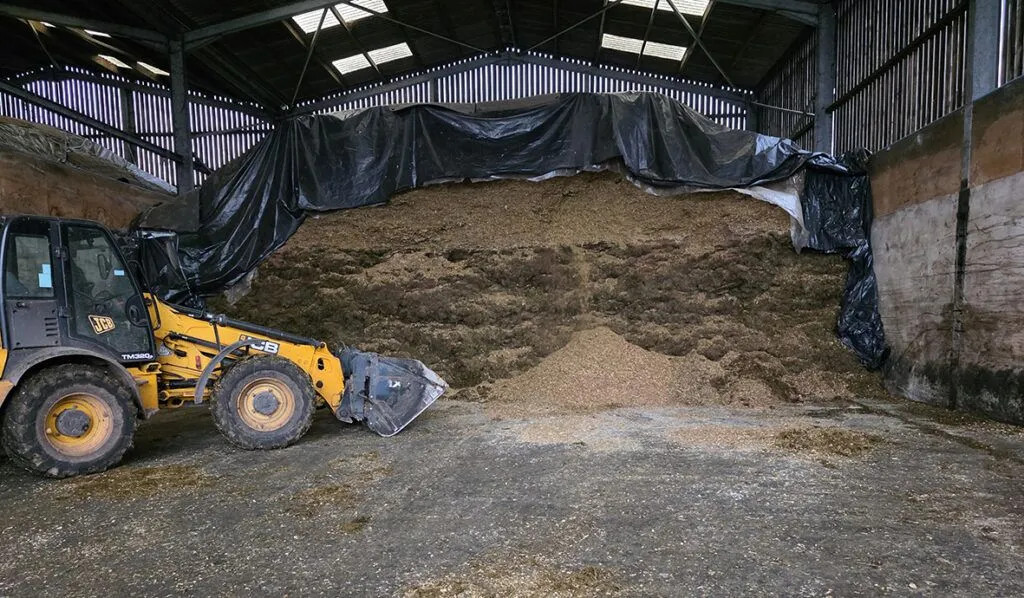
In a bid to improve the quality and stability of his maize clamp, Somerset dairy farmer, Chris Briggs tested a new silage additive which has sped up fermentation to keep the clamp cooler and reduce losses in a challenging forage year.
Working with Mole Valley Farmers and Rumenco, Mr Briggs added NovaSileCS, a new silage additive to his maize during the harvest of 2025. He grows 150 acres of maize on sandy soils and 300 acres of grass for silage to make up his TMR.
“We take two cuts and 2025 was not the best year because of the drought. However, we do get a good maize crop and, thankfully, 2025 delivered a bumper crop that has helped us through winter. Grass and maize are clamped together and this year we wanted to make sure that there was no waste,” says Mr Briggs.
With forage quantity and quality at risk from the drought conditions, he decided to trial NovaSileCS in an attempt to improve the stability of his clamp.
“We couldn’t afford to have any waste, and I wanted to take every measure to protect the yield we had managed to take. We have never used a silage additive before so I was naturally cautious, but the result has been an eye opener because this year’s clamp has fed out perfectly, with hardly any steam or pockets of spoilage,” he adds.
Mr Briggs farms in partnership with his wife Kathleen at Kerndon Farm, near Taunton in Somerset. The couple milk 243 from a flying herd of 285 Holsteins that produce 7500 litres per cow per year.
“We graze the herd and run a low input system with just a little cake in the parlour. Our goal is to maximise milk from forage so we have been trying to find ways to boost this by making better silage,” he says.
Since feeding the treated maize silage he has seen an uplift in milk of 2.5 litre per cow per day. A figure that can only be attributed to silage quality as there have been no other changes to the farm system. The milk averages 4.63% butterfat and 3.39% protein and the herd is fed almost entirely on homegrown forage.
“There is no doubt that the additive has increased the nutritional value of the maize. It is 35% dry matter, with an ME of 11%. Protein is good at 8% and the D value is 68%. It has driven our milk from forage percentage up to 57%, which makes our system both cost-effective and efficient,” he says.
These results support earlier trials with NovaSileCS, which consistently demonstrated improved silage nutrient quality across a broad variety of forage crops.He plants late, normally around the second week of May and harvests in October. With 150 acres representing a third of his land, he relies heavily on the maize crop being good quality.
“We test our soils every year and rarely need to add lime because we bed on sea sand. However, the maize is grown on rented land, so we make sure it gets plenty of slurry through the growing season,” he says.
6000 gallons of slurry per acre is applied to the maize land to improve organic matter and provide the optimum amount of natural fertiliser. He also applies the sand and silt from the slurry store, when it has been emptied, to provide additional soil nutrients.
The maize crop was harvested with 200-gram sachets of NovaSileCS used to treat every 100 tonnes of fresh forage. The additive contains a bespoke blend of complementary bacteria that preserve silage nutrients and minimise losses.
The two fast-acting lactic acid producing bacteria within NovaSileCS quickly reduce the pH level of silage, to protect its nutrient value. Whilst the acetic acid producing bacteria prevents yeast and moulds from developing and causing spoilage through heating. Ultimately, keeping silage cool, stable and higher quality which supports better livestock performance.
“We have seen pockets of spoilage in the past and really wanted to see if we could get through an entire maize clamp without suffering losses. We are a good way through the clamp now and it has been much cooler and, as yet, we haven’t had to waste any,” he says.
With silage quality and quantity a concern in some parts of the UK, and with feed stocks down for many, 2026 will be a crucial year to optimise forage production. With its ability to improve silage quality, speed up fermentation and provide a higher dry matter and nutrient rich forage, the use of forage additives like NovaSileCS is likely to be an attractive option for many livestock farms next year.
“We have been surprised at how effective the additive has been and impressed with how stable the clamp has been this winter. With weather extremes affecting forage availability and quality, we are committed to making the best of what we have and the additive has definitely helped with that,” he concludes.